
ISLAMABAD: The government invited the opposition on Monday to hold talks and “strengthen and take forward” the Charter of Democracy — a 2006 document signed by PML-N supremo Nawaz Sharif and late Benazir Bhutto, with the commitment to struggle against dictatorship.
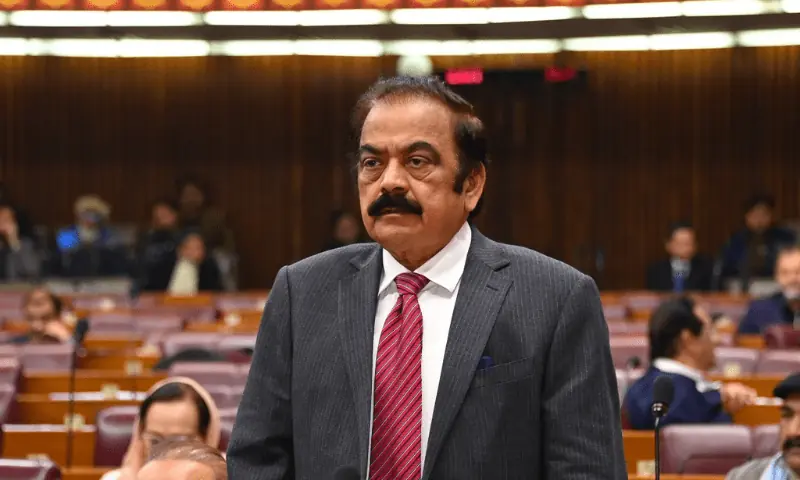
“Let us sit together to strengthen and take forward the Charter of Democracy”, Adviser to the Prime Minister on Political Affairs Rana Sanaullah said while addressing a Senate session in response to a speech by Opposition Leader Raja Nasir Abbas.
Sanaullah said the government was willing to hold dialogue with the opposition, which would strengthen democracy, rather than opting for confrontation and deadlock.
“We are ready to sit with you for the betterment of the country,” he asserted, maintaining that parties in the ruling coalition had stressed the need for talks even when the PTI was in power.
However, PTI founder Imran Khan was not ready to talk to politicians, he said, saying that his “stubbornness is a big hurdle” in the way of talks.
Without naming anyone but seemingly referring to the establishment, Sanaullah went on to say that the opposition wanted talks with those who did not want to talk to it.
He added that the government wanted the PTI to “become a part of Parliament by rejoining its standing committees”.
The PTI had resigned from the standing committees in September last year.
Sanaullah criticised the party on Monday for what he described as its “reluctance to become a part of the political process”.
Continuing his rebuke of the opposition, the PM’s adviser stated: “You don’t want to talk to those who desire so.” But, he added, the government was ready to move forward in a democratic manner.
He invited the opposition to collaborate on economic and democratic pacts, emphasising that negotiations were held between political parties and not “through external forces”.
On Imran’s health, he said the matter was before the court, and the government had implemented court directives regarding the PTI founder’s treatment.
“On the PTI’s request, even an eye specialist was included in the medical board that examined Imran,” he highlighted.
The incarcerated ex-prime minister’s health has been garnering attention in recent days, with his family and party raising concerns since his eye ailment — right central retinal vein occlusion (CRVO) — came to light in late January.
Meanwhile, the government and the opposition have also been engaged in a blame game, with the latter accusing the former of a lack of transparency on the matter, not ensuring appropriate treatment for Imran and not allowing his personal physicians to access him. The government denies these allegations.
Speaking before Sanaullah, Opposition Leader Abbas criticised the authorities in connection with a recent days-long sit-in at the Parliament House over concerns regarding Imran’s health.
He claimed that “Parliament was shut down to block the entry and exit of parliamentarians who were staging a peaceful protest”.
“Is this not an insult to Parliament?” he questioned.
Abbas said the protesters’ only demand was Imran’s medical treatment should be carried out in the presence of his personal physicians and to the satisfaction of his family.
He neither wanted a release from jail, nor his family made any such demand, Abbas said, adding that the PTI founder only sought a fair trial for himself.
Calling for the need to restore confidence on both sides, he urged the government not to transform this issue into a “full-blown crisis” and move forward.
He also gave the assurance that the opposition would “never become part of any conspiracy to topple the government at the dictation of any dictator, despite the legitimacy of the [incumbent] government being questioned”. But, he stressed, the government should address and resolve the issue of Imran’s eye ailment and treatment.
He also reiterated his demand that a parliamentary committee should be formed to meet the jailed ex-premier and examine his health conditions.
While Sanaullah was responding to Abbas’ allegation of “shutting down Parliament”, he said the opposition’s call to its workers to reach the protest venue prompted the police to “make security arrangements”.
About the Author