

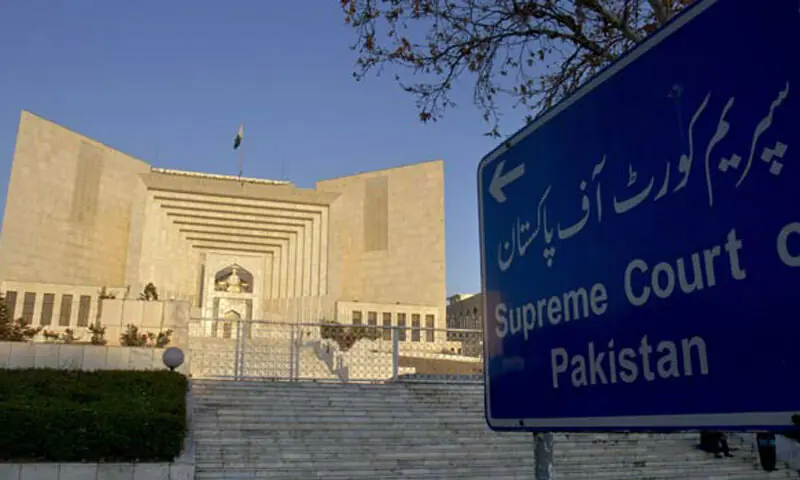
SC emphasises impartiality of electoral officers, says any deviation imperils democratic order itself has drawn attention as part of the latest developments being reported. Below is a cleaned summary based on the feed item.
ISLAMABAD: The Supreme Court on Wednesday affirmed that the discharge of electoral duties demanded scrupulous adherence to the law, transparency in action, and an unwavering commitment to impartiality. “Any deviation from neutrality or departure from the statutory framework, during the election process, imperils not merely the outcome of a particular election, but the democratic order itself,” emphasised Justice Shakeel Ahmed. Justice Ahmed observed that “only through these principles public confidence in the electoral process is sustained and the sovereign will of the electorate is preserved”. Justice Ahmed was a member of the three-judge bench that overturned the Nov 24, 2025 Balochistan Election Tribunal’s ruling and had ordered the Election Commission of Pakistan (ECP) to notify Pakhtunkhwa National Awami Party’s (PNAP) Khushal Khan Kakar as the returned candidate from NA-251 (Sherani-cum-Zhob-cum-Killa Saifullah) for the February 8, 2024 general election. Headed by Justice Shahid Waheed, the court had taken up a set of appeals moved by Kakar and his opponent, Syed Samiullah, of the Jamiat Ulema-i-Islam. The controversy arose after the 2024 general election, where respondent Samiullah was initially declared the returned candidate by the ECP on Feb 18, having secured 46,210 votes against the appellant’s 46,117 votes. Challenging this notification, Kakar filed an election petition before the Election Tribunal, which was partly allowed. The tribunal directed the ECP to carry out repolling at 22 disputed stations and declared the election of the returned candidate void. In his detailed reasons, Justice Ahmad observed that the electoral functionaries are trustees of the people’s mandate and custodians of the integrity of the electoral process. He explained that Form-45 constitutes a primary and contemporaneous record of votes counted at each polling station and is prepared immediately after completion of the counting process, in the presence of candidates or their duly authorised agents, and, therefore, carried statutory sanctity. Form-48, by contrast, is merely a consolidated statement derived from the Forms-45, the judgment said, adding the returning officer (RO) exercises no adjudicatory authority to vary, substitute or recompute the result recorded in Forms-45, except to correct patent clerical mistakes apparent on the face of the record and strictly in accordance with law. “The RO is bound to strict statutory duties, including neutral and transparent conduct of the election,” the judgment said, adding the RO must act as an impartial officer responsible for maintaining the integrity of the electoral process. Justice Ahmad emphasised that RO must simply compile the result from Forms-45 into Form-48, but “cannot modify or alter the votes unless ordered or an obvious clerical or arithmetical mistake was discovered and corrected transparently in accordance with law”. “The RO must also ensure that the record accurately reflects the votes polled”, the judgment said, adding: “If the RO deducts votes from a candidate and adds them to another without lawful authority, the act constitutes tampering with election results, abuse of statutory process and violation of election laws.” Such conduct has “materially affects the election results and undermined the democratic process”, Justice Ahmad regretted. The discrepancy between Forms-45 and Forms-48, in the present case, indicates a serious irregularity. By reducing the votes of the appellant and adding them to his rival/the respondent, the RO appears to have exceeded his statutory powers and possibly acted with malafide intent, Justice Ahmad regretted. Such an alteration, which completely reversed the election results, materially affects the outcome of the elections and undermines the integrity of the electoral process, he said. Justice Ahmed further said that the controversy brought before the SC strikes at the very heart of Constitutional democracy and the sanctity of the ballot. In a constitutional order founded upon representative governance, the legitimacy of public institutions ultimately rests upon the integrity, transparency and credibility of the electoral process. Where doubts arose, whether the will of the electorate, as expressed at the polling stations, has been faithfully carried through the statutory process of consolidation, the matter assumes significance beyond the fortunes of individual candidates, he said. Justice Ahmad reminded that Article 218(3) of the Constitution enjoins upon ECP the solemn and non-negotiable duty to organise and conduct elections honestly, justly and fairly, and to vigilantly guard against corrupt practices. “This constitutional command is not directory, but mandatory. Any manipulation at the stage of vote consolidation erodes democratic legitimacy and shakes the foundations of the people’s mandate,” he said. An administrative officer cannot be allowed to substitute his arithmetic for the sovereign will of the electorate. Where the true count of votes is evident from uncontroverted Forms-45, duly acknowledged by ECP, no shadow can be cast upon their authenticity, Justice Ahmad said. He also emphasised that the SC was not powerless; where the evidence conclusively demonstrates that the appellant secured a lawful majority, the proper course was not to direct a re-poll, but to declare the appellant duly elected. “The law neither condones manipulation nor permits its fruits to endure. Tampering at the consolidation stage by the RO is even more perilous than irregularities at the polling station,” Justice Ahmad emphasised.
Why this matters
This update matters because iSLAMABAD: The Supreme Court on Wednesday affirmed that the discharge of electoral duties demanded scrupulous adherence to the law, transparency in action, and an unwavering commitment to impartiality.
Source: Original report
About the Author