
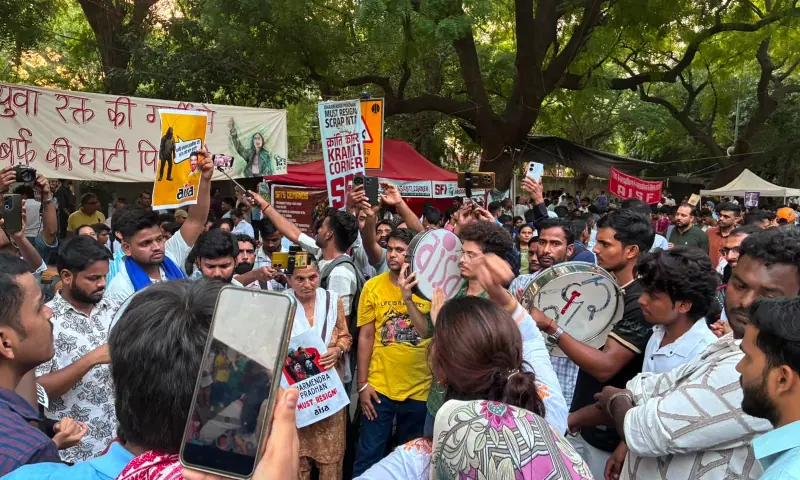
“Sonam sir is not doing so well, and his rib cage has started showing,” said Vijeta Dahiya, spokesperson for the Cockroach Janata Party (CJP), speaking from New Delhi, where the educationist, Sonam Wangchuk, is on the 19th day of hunger strike. “He’s nearly 60, has lost muscle mass; the heat and humidity are not helping either and I can see him having dizzy spells,” he added. Wangchuk, a well-known public figure in India and among international water conservation circles, is known for innovations such as the ice stupa, which communities in Pakistan’s Baltistan region have also sought to replicate. He is a recipient of the Ramon Magsaysay Award, often referred to as Asia’s Nobel Prize. Last year, he was invited to speak at Dawn’s Breathe conference. “His coming aboard has given our cause a huge boost,” said Dahiya and explained how the online satirical political movement, founded on 16 May 2026, emerged in response to remarks by Justice Surya Kant, a judge of the Supreme Court of India, likening unemployed youth to “cockroaches.” Since then, it has gained momentum while campaigning against examination scandals, unemployment and other governance issues. The protest at Jantar Mantar began on 20 June with a demand for the resignation of the Education Minister Dharmendra Pradhan, following the leak of question papers for the National Eligibility-cum-Entrance Test (NEET), India’s highly competitive medical college entrance examination, which was subsequently cancelled. “Paper leaks have been recurring for years,” he said. “In fact, according to our records, 22 disillusioned students committed suicide following this year’s NEET paper leak,” he said, adding, “The count is much higher over the years.” Natasha Badhwar, a filmmaker and author, met Wangchuk with a group of journalists. “He told us not to save him or ask him to stop his hunger strike and instead put the same energy into the cause and press the government to listen to the demands of the youth.” Dahiya said many young people are participating in the hunger strike alongside “Sonam Sir” since the protest began and while some gave up after their health deteriorated, others are still carrying on. “Overall, around 30 people have participated in the hunger strike, and even more are observing it for different durations from their homes,” he said. “It is the Indian way of non-violent protest,” said Badhwar, tracing the tradition back to Mahatma Gandhi. “Others have also undertaken hunger strikes—during the anti-dam movements, for instance, or in protest against corruption,” she said. The longest such protest was by environmentalist Professor G.D. Agrawal (Swami Sanand), who undertook a hunger strike in 2018 to demand stronger protection for the Ganges. He died on October 11, that year, on the 111th day of his fast, at the age of 86. If the hunger strike echoed a long tradition of moral protest, the gathering at Jantar Mantar reflected its contemporary expression. “To be out there in a space that was hot, smelly, noisy, crowded and packed, and yet feel completely safe—that feeling was palpable,” said the filmmaker, describing the sense of solidarity she experienced at Delhi’s traditional venue for public protests. At the same time, she describes it as a “sensory onslaught” — with smells, banners, security personnel, television cameras, people taking selfies, familiar faces at every turn and new acquaintances being made. “That’s how protest sites are in this part of the world,” said Badhwar. “We’ve constantly been announcing and appealing to people to set an example and remain peaceful, egalitarian, giving examples of Gandhiji and [B.R.] Ambedkar; and people have listened!” said Dahiya, adding that there had not been a single reported incident of misconduct towards women. Badhwar agreed. Despite attracting thousands of visitors and hosting food stalls, the protest site has remained remarkably orderly and safe, despite having been in place for almost a month through the relentless Indian summer. She also found positive energy through “street theatre, performances, lectures, people sitting together in conversation and journalists conducting interviews”. Seeing young people and ordinary citizens come together, she said, created an atmosphere of shared purpose and hope. “It was a spectacle of democracy at work,” she said, and added, “And it was deeply reassuring.” It also reminded her of the protests against the Citizenship Amendment Act in 2020, she said. “Because so much of our public conversation now happens online, people have stopped coming together physically in this way.” The protest has drawn not just ordinary citizens but well-known public figures and politicians. The only ones conspicuous by their absence are the state representatives. “Not a single government official has come to us,” said Dahiya. Describing the non-violent protest as “a desperate measure in desperate times,” Badhwar said she understood the need to remain in the public imagination, particularly when neither the mainstream media nor the government appeared to be paying much attention. For now, all eyes are on July 20, when members of the CJP will march from Jantar Mantar to Parliament, where lawmakers will be in session. “I don’t know how many people will actually march with us,” said Dahiya. “We’ve asked those who want to join to register by giving us a missed call and based on those responses that we have received so far, we’re expecting several thousand participants. But we’ll only know the actual numbers when the march begins.” Badhwar views the planned march with some trepidation, drawing on her experience of past street protests. “There is a possibility that they could be pushed back by opposing forces,” she said. “If that happens, there is always the risk of violence.” She recalled that during the protests against the Citizenship Amendment Act, many first-time women protesters were detained by law enforcement agencies and, according to activists, some remain imprisoned on what they describe as trumped-up charges. If there is one thing the CJP is determined about, it is maintaining non-violence. “There will be no vandalism and no violence,” Dahiya said firmly. “It will be nothing like what happened in Nepal, Bangladesh or even Sri Lanka. India will show to the world that peaceful resistance can bring in change.”
Source: Original report
About the Author