
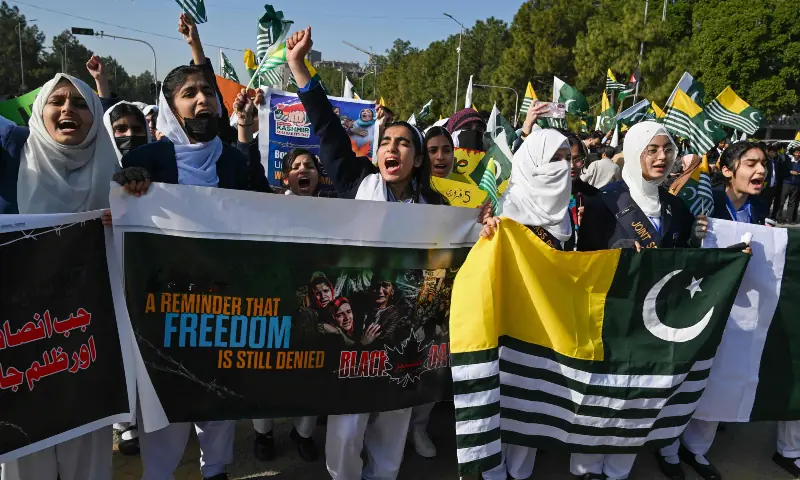
The nation is observing Kashmir Solidarity Day today with a renewed pledge to support the just struggle of the Kashmiri people for their inalienable right to self-determination.
The day will feature rallies, demonstrations and seminars throughout the country. Human chains will also be formed at all entry points of Azad Jammu and Kashmir (AJK).
One-minute silence was observed across the country at 10am to pay homage to the martyrs of the Kashmir freedom movement, state-run Radio Pakistan reported.
In his message to mark the occasion, President Asif Ali Zardari reiterated Pakistan’s steadfast moral, diplomatic and political support for the Kashmiri people, reaffirming their “inalienable right to self-determination” as enshrined in the relevant resolutions of the United Nations Security Council (UNSC).
The president said the people of Pakistan across the globe stand united with their Kashmiri brothers and sisters in their just struggle.
He recalled that the observance of Kashmir Solidarity Day was initiated 36 years ago by ex-premier Benazir Bhutto following the historic Kashmiri uprising of 1989, a movement that continues to this day.
President Zardari urged the international community to press India to end human rights violations in held Kashmir.
He said India had intensified efforts to entrench its control through “administrative and legislative measures, curbing media freedoms, incarcerating Kashmiri leadership and attempting to alter the demographic composition of the territory”.
The president also highlighted what he described as grave human rights violations by Indian occupation forces, citing international reports that point to a rise in arbitrary detentions, collective punishment and punitive house demolitions.
He added that the “suppression of digital freedoms, including the blocking of thousands of social media accounts, reflected attempts to conceal the realities on the ground”.
In his message on the occasion, Prime Minister Shehbaz Sharif called for the dispute’s resolution in accordance with UNSC resolutions.
He urged the international community to play an effective role in getting the Kashmiri people their “inalienable right through a free and impartial plebiscite under the auspices of the United Nations”.
He also announced that the government has increased the monthly per capita subsistence allowance of Kashmiri refugees to Rs5,000.
“The government of Pakistan is conducting a pilot project to construct 750 residential houses at a cost of Rs3 billion,” PM Shehbaz said.
The premier said the AJK government has provided land for the construction of these houses, exclusively meant for Jammu Kashmir refugees settled in the territory.
He said complete rehabilitation of the refugees of Jammu and Kashmir is a national duty, and Pakistan will stand with the Kashmiris until they achieve their right to self-determination.
PM Shehbaz visits AJK
PM Shehbaz was on a visit to Muzaffarabad to address the special session of the AJK Legislative Assembly, APP reported.
Addressing the AJK Legislative Assembly, the premier said, “Today, we have gathered here to stand in solidarity with our brothers in [occupied] Kashmir on behalf of the Pakistani people and the Pakistani leadership.
“Soon, the freedom and nation of our Kashmiri brothers and sisters […] Kashmir will become a part of Pakistan.”
The prime minister paid tribute to leaders of the Kashmiri freedom movement, including Burhan Wani, Asia Andrabi, Yasin Malik and All-Parties Hurriyat Conference Chairman Mirwaiz Umar Farooq.
“History has shown that Kashmiris can sacrifice themselves or their children but will not compromise on their freedom,” PM Shehbaz noted.
“Kashmiris show the world every day the mirror of reality. They announce every day that Kashmir has never been a part of India, it is not, and it will never be,” he further said.
“The solution to the Jammu-Kashmir dispute is to honour the wishes of the people of Kashmir and the implementation of the UNSC’s resolutions,” the prime minister said.
“India has no way other than this.”
PM Shehbaz affirmed, “Pakistan will continue to speak in favour of Kashmir until the birthright of Kashmiris’ freedom is given to them.”
Recalling the four-day conflict between Pakistan and India in May 2025, he quipped, “Our brave armed forces, under the courageous leadership of Field Marshal Syed Asim Munir, meted India such a defeat that even their generations would not be able to forget.”
“Our victory during Marka-i-Haq was also a victory of the Kashmir cause and the sacrifices made by Kashmiris,” he said, pointing out that the Kashmir cause was diplomatically “reignited with full force” in the wake of the conflict.
The prime minister then turned his attention towards the surge in terrorism in the country.
“After suffering defeat in Marka-i-Haq, India is now intensifying terrorism through proxies,” PM Shehbaz said.
He asserted that peace cannot be established in the region until India’s “aggressive, expansionist, dominating and nefarious schemes come to an end”.
“The brave armed forces and security forces of Pakistan will do the same to the puppets involved in Indian terrorism that they did to Indian jets in Marka-i-Haq,” the premier quipped.
However, he emphasised, “We want peace, but this peace can be established on the basis of equality and justice. No matter what front India opens or what language it uses, we will respond there in an unforgettable way.”
The prime minister underscored Pakistan’s principled stance on the Palestine and Kashmir issues.
PM Shehbaz said the Centre will continue to work with the AJK government to further develop education, infrastructure and health facilities in the territory.
“Recently, I was informed that the people who migrated from occupied Kashmir in 1989 have a stipend of only Rs3,500 per month, and it was requested that it should be increased to Rs5,000. I did not agree with that and said that it should be increased to Rs6,000,” he said.
Announcing the establishment of a Daanish school in Muzaffarabad, he said, “Rs9.4 billion have been allocated for water supply schemes and hydropower projects in Neelum, while Rs10bn have been allocated for the construction of Haryam Bridge.”
He went on to detail that Rs1.40bn have been allocated for the University of Kotli and Rs1,46bn for a women’s university in Bagh.
The premier also remembered AJK President Barrister Sultan Mehmood Chaudhry, who passed away recently, saying: “He committed his entire life to the freedom of Kashmir.”
In his speech to the assembly, AJK PM Raja Faisal Mumtaz Rathore noted that both the political and military leadership of Pakistan were expressing solidarity with the people of occupied Kashmir.
“Pakistani soldiers have never hesitated to make sacrifices for Kashmir,” he said.
Rathore highlighted that the country’s political leadership has never differentiated on the issue of Kashmir.
“On the one hand, there is India that has turned Kashmir into a jail, and then there is Pakistan, which is sensitive to even the smallest of our difficulties,” he said.
On his arrival, PM Shehbaz was welcomed by his AJK counterpart and senior government officials.
The prime minister is accompanied by Deputy PM and Foreign Minister Ishaq Dar, Planning Minister Ahsan Iqbal, Information Minister Attaullah Tarar, Religious Affairs Minister Sardar Yousaf, and Advisor to the PM on Inter-Provincial Coordination Rana Sanaullah.
Concrete action needed to alleviate Kashmiris’ suffering: armed forces
On behalf of the armed forces, Chief of Defence Forces (CDF) and Chief of the Army Staff Field Marshal Asim Munir, Chief of the Naval Staff Admiral Naveed Ashraf, and Air Chief Marshal (ACM) Zaheer Ahmed Baber Sidhu reaffirmed their unwavering support for the “resilient people of Indian Illegally Occupied Jammu and Kashmir (IIOJK) in their epic struggle for self-determination”.
In their message, issued by the Inter-Services Public Relations (ISPR), the services chiefs strongly condemned “grave violations of human rights in IIOJK, including extrajudicial killings, enforced disappearances, arbitrary detentions, and attempts to alter the demographic and political landscape of the region, with blatant disregard for international law”.
They reiterated that a “just and peaceful resolution” of the Jammu and Kashmir dispute, in accordance with the UNSC resolutions and the aspirations of the Kashmiri people, “remains essential for lasting peace and stability in South Asia”.
“The international community must take concrete and meaningful action to alleviate the suffering of the Kashmiri people,” the services chiefs added.
They reaffirmed that the armed forces remain “steadfast in their duty to safeguard Pakistan’s sovereignty and territorial integrity, and unwavering in their solidarity with their Kashmiri brothers and sisters in their rightful quest for freedom and dignity”.
“Long live Pakistan! Long live Kashmir!”
A separate statement later issued by the ISPR said CDF Munir visited Muzaffarabad today where he paid homage to the martyrs of the freedom struggle and laid the wreath at the Jammu and Kashmir Martyrs Monument.
He “offered rich tributes to the Shuhada of Kashmir movement, acknowledging their enduring legacy of valour and selfless sacrifice,” the statement said.
It added that while interacting with the notables and veterans, the CDF reiterated Pakistan’s unwavering political, moral, and diplomatic support for the people India-occupied Kashmir.
“He noted that Indian atrocities, unabated violations of human rights, and Hindutva-driven excesses have failed to suppress the legitimate struggle and the aspirations of the Kashmiri people,” the statement said.
Reaffirming Pakistan’s steadfast support for the Kashmiri cause, CDF Munir stated that Kashmir would soon “witness the dawn of freedom, in accordance with the will and destiny of the people of Kashmir”, the statement added.
According to the statement, he emphasised that Pakistan would continue to highlight the Kashmir issue at all relevant international forums, in “complete solidarity with our Kashmiri brothers and sisters, until a just resolution of the dispute is achieved according to the United Nations Security Council resolutions”.
He commended the unwavering dedication, high morale, professional excellence, and combat readiness of the officers and soldiers deployed in Azad Kashmir despite challenging operational conditions.
The CDF emphasised the imperative of maintaining peak operational preparedness, vigilance, and seamless synergy across all domains to effectively deter and decisively respond to any hostile provocation.
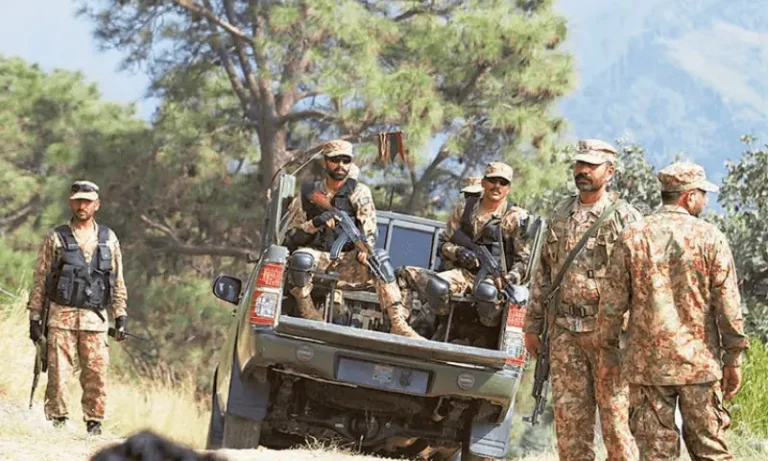
He also visited a forward post, where he interacted with troops deployed on the frontlines, the ISPR statement said, adding that during the visit, the CDF reiterated that any act of aggression would be instantaneously met with a swift and befitting response.
“He underscored that the armed forces remain fully prepared to counter both conventional and hybrid threats in an evolving security environment,” the statement said.
India’s ‘persistent defiance’ undermines UN Charter, UNSC resolutions: Dar
FM Dar, in a statement, highlighted that the Kashmiri people “remain deprived of their fundamental rights”. “Yet, their resilience testifies the legitimacy of their just cause.”
“At the heart of the Jammu and Kashmir dispute lies India’s failure to implement the United Nations Security Council resolutions guaranteeing the Kashmiri people a free and impartial plebiscite,” the foreign minister noted.
He pointed out that India’s “persistent defiance” undermines the UN Charter, the relevant UNSC resolutions and the Fourth Geneva Convention.
The situation on the ground in occupied Kashmir has “moved beyond episodic violations to a sustained system of repression”, Dar remarked.
He accused India of taking actions after Aug 5, 2019 for “artificially altering the demographic composition to change Muslim majority into majority into minority”.
“Under the Hindutva-driven framework, people in IIOJK face constant discrimination. The recent profiling of mosques in IIOJK, where religious functionaries are forced to provide their personal details, photographs, and sectarian affiliations, shows the extent of institutionalised Islamophobia,” the statement read.
FM Dar took note of “grave human rights violations, including fake encounters, enforced disappearances, arbitrary detentions, and restrictions on fundamental freedoms”.
He urged the international community to take “decisive action to address the worsening human rights situation in IIOJK, ensure accountability for India’s illegal and unilateral actions, persuade India to implement the [UNSC] resolutions and allow the Kashmiri people their promised right to self-determination”.
In his message, National Assembly Speaker Sardar Ayaz Sadiq noted that the Kashmir issue remained one of the fundamental disputes stemming from the incomplete promises of the partition of the subcontinent.
He stressed that sustainable peace in South Asia cannot be achieved without granting the Kashmiri people their internationally recognised right to self-determination.
Rallies held
Minister for Kashmir Affairs Engineer Amir Muqam led a rally from China Chowk to D-Chowk in Islamabad to mark the day, APP reported.
A ceremony marking Kashmir Solidarity Day was also held at Kohala Bridge, where participants formed a human chain and reaffirmed support for the people of Kashmir.
The event included flag hoisting and the playing of the national anthem, with officials, community representatives and citizens in attendance.
Sindh Chief Minister Murad Ali Shah led a Kashmir Solidarity Day rally in Karachi, marching from People’s Chowrangi to Mazar-i-Quaid.
Members of the provincial cabinet, the Sindh chief secretary and police chief, and other government officials participated in the rally.
Addressing an event, CM Murad recalled that in 1973, “when Kashmiris decided to join Pakistan, India illegally deployed troops” there.
“Ever since, Kashmiris’ right to self-determination has been suppressed by India,” he added.
“It is clear that this is not a decision between two countries, but India must be held accountable and the world must fulfil its promise to Kashmiris,” the chief minister said.
“In the Kashmir issue, everyone is united; there’s no political difference, no ethnicity. Everyone speaks as one on Kashmir,” he highlighted.
‘Kashmir fundamental pillar of Pakistan’s identity’
Separately, at a ceremony held at Pakistan’s embassy in Kabul, Pakistan’s envoy to Afghanistan Ubaidur Rehman Nizamani also reaffirmed the country’s “commitment to the struggle of the Kashmiri people”.
According to a press statement issued by the embassy, Ambassador Nizamani “framed the Kashmir cause as a fundamental pillar of Pakistan’s own spiritual and national identity”.
Addressing the event, the envoy also “emphasised that the stability, security, and very ideological foundation of Pakistan are inextricably linked to the freedom of Kashmiri brethren from Indian occupation”.
About the Author