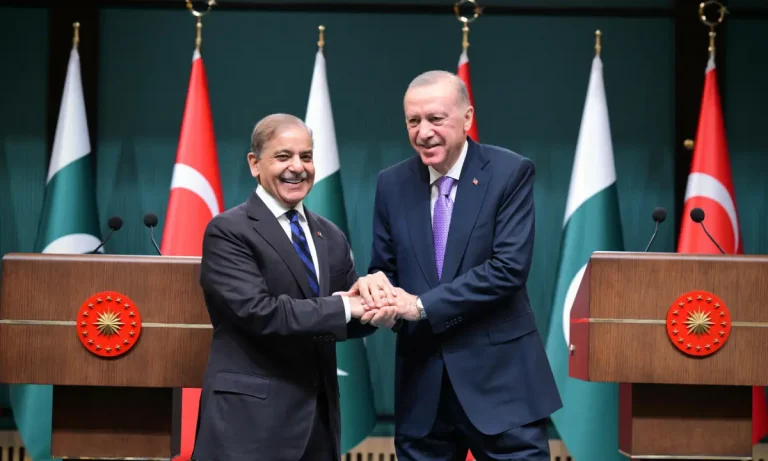

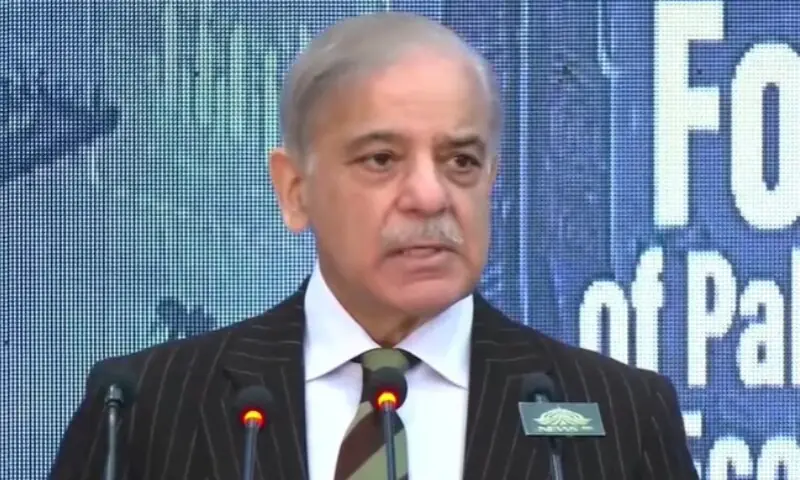
Prime Minister Shehbaz Sharif on Friday announced a Rs4.4 reduction in the per unit rate of electricity for the industrial sector in a bid to improve productivity and exports.
The premier stated this during an address to the country’s major exporters and business figures at a ceremony in Islamabad, which was held to honour their contributions.
“A Rs4.4 reduction is being made in the electricity unit rate for industries,” said the premier, adding that “if it were in his control, he would reduce it by another Rs10.”
“However, my hands are tied, as you all know well,” he said.
PM Shehbaz also announced a reduction in wheeling charges for industries, stating that “it will be less than Rs9”. He hoped that the move would help “industries sell their power to neighbouring industries”.
To provide additional relief, the premier said that “with the cooperation and support of Pakistan’s banks, we are announcing a reduction in the export refinance rate from earlier 7.5pc to 4.5pc”.
At the outset of his address, the premier lauded business leaders and major exporters for their “hard work and efficiency for achieving major milestones in their relevant sectors in the past year”.
“The billions of rupees you have earned for Pakistan, the entire nation congratulates you [on that],” PM Shehbaz said.
The premier recalled that in 2023, the country was on the brink of default.
“Day and night, there were reports that Pakistan was going to default,” he said, adding that it was a “big challenge for the nation”.
The premier recalled a meeting with International Monetary Fund (IMF) Managing Director Kristalina Georgieva in Paris, during which she flagged Pakistan’s inconsistency during previous programmes.
He recalled the lending agency’s managing director as saying: “I was told that time was running out, and it will be difficult to offer a new structure.”
PM Shehbaz added, “I told her that I was giving her my word of honour that we will ensure implementation and commit to the agreement in letter and spirit.
“When I came back to Pakistan, she called me to tell me [..] that our team will sit down with you and you must honour the commitment you made. This is how Pakistan was saved from default.”
Shifting his attention to the present situation, PM Shehbaz continued: “At this moment, in the third quarter, our foreign exchange reserves have doubled, but that includes loans from friendly countries as well.”
PM Shehbaz detailed that he, along with Chief of Defence Forces and the Chief of the Army Staff Field Marshal Asim Munir, went to many countries for assistance, told them about the IMF programme and requested them for funds.
The premier said he was “grateful to the countries for helping, […] but you know whoever takes a loan, […] there are obligations associated with it”.
“China helped us out in the most difficult of times, as well as Saudi Arabia, the United Arab Emirates (UAE) and Qatar,” he said, adding that “this is how the programme was stitched”.
‘Pakistan has become a stable economy’
The premier, during his address, also stated that he could now say “without hesitation” that Pakistan’s economy had become “stable”.
PM Shehbaz noted that the inflation was in “single digits and the policy rate is at 10.5 per cent”.
The premier recalled that “there was a time when the policy rate used to be 21.5-22pc, and inflation was galloping,” adding that people did not know what was to come.
“We faced a lot of difficulties, and our industrialists and businessmen faced these difficulties head-on,” PM Shehbaz recalled. “There was hope that maybe there would come a better time, and Pakistan would be on its way to progress.”
However, he cautioned that while the “economy has stabilised, this is not enough”.
“I want to present a harsh reality to you,” he said and went on cite increased poverty and unemployment rates and the dearth of profits from current exports.
He noted that industries were struggling to compete with other countries due to higher costs.
The prime minister also acknowledged that “the government cannot dictate the private sector,” and stressed the need for moving towards sustainable growth.
“We have to grow our economy, and it has to be sustainable, and we must encourage export-led growth,” he said, stressing that there was “no other way”.
The premier also spoke in favour of encouraging small- and medium-sized enterprises (SMEs). He stressed that the private sector and the government must “hold the hand of SMEs” in order to provide support.
PM Shehbaz expressed “full faith” in business leaders’ “vision and commitment, which he said held the potential to “transform Pakistan’s economy in a few years”.
As he appreciated their role, he also announced blue passports for the exporters awarded during the ceremony and declared them “ambassadors at large”.
‘Restore PIA to its past glory’
During his address, the premier also recalled the recent privatisation of Pakistan International Airlines (PIA), expressing hope that the airline would soon be restored to its “past glory”
“PIA’s legacy — ‘great people to fly with’ — was on banners in London and Brussels […] Where did that era go?” he said, adding that it used to be one of the “top ten” airlines in the world.
“I think this is what we need to revive,” he stressed.
“I have full faith that he (Arif Habib) and his partners can revive that era. I want to reiterate that once again, you have the full support of the government,” the premier said.
A consortium led by Arif Habib Corporation Limited had won the auction for 75 per cent shares of PIA in December last year, after making a winning bid of Rs135 billion.
About the Author